
Custom AI Agents, Built Into the Stack You Already Run
You already know which workflow hurts: the reporting pack that eats two days a month, the content queue that never clears, the enrichment nobody has time to do properly. We build the agents and automation pipelines that carry that work, grounded in your own data and your own quality standards, running inside the tools your team already opens every morning, with a human approving anything that needs judgement.
Where Marketing Automation Builds Go Wrong
Most builds do not fail because the technology was not ready, but because they were pointed at the wrong workflow or built somewhere the team does not work.
The Demo Works and the Workflow Does Not Change
An agent gets built, it demos beautifully on a curated example, and three weeks later nobody is using it, because it sits in a separate tool that nobody opens and it produces output the team rewrites anyway. A build only survives if it lands inside the process that already exists: the same brief, the same review, the same place the work is stored. Anything that asks people to go somewhere else to get the value is a prototype, and prototypes quietly die at the first busy week.
The Agent Has Nothing to Stand On
AI is only as good as the context it can draw on, and most marketing teams have never built that layer: the data sits across separate platforms, the process lives in people's heads, and the quality standards are implicit rather than written down. So the agent guesses. It writes copy that sounds like everyone's copy, and it summarises a report without knowing which number the business actually cares about, and the team concludes AI cannot do their work when what was missing was the grounding. Documenting how the work is really done has to come before automating any of it.
Nobody Owns What Happens When It Gets It Wrong
Every automated workflow eventually produces something wrong, and the thing that decides whether the build survives is who catches it. Teams that put an agent in front of a client-facing process with no approval step get one bad output and switch the whole thing off, whereas teams that design the gates first, deciding what a person signs and what runs unattended, keep the speed and keep the trust. Governance is not the paperwork after the build. It is part of the design.
The Builds That Carry Marketing Work
Four patterns cover almost everything worth automating inside a marketing function, and the same builds already run underneath our own GEO and SEO delivery. If you do not yet know which workflow to point a build at, an AI maturity assessment on our AI marketing consulting page finds it, because automating the wrong workflow is expensive and slow to undo.

Content Operations Agents
Briefing, drafting, repurposing and publishing, rebuilt as one pipeline rather than a chain of handoffs. The agent works from your brand standards, your tone rules and your existing library instead of a model's general idea of good copy, and a strategist still approves before anything goes out. Our own blog publishing workflow runs this way, and it came down from more than eight hours to two.

Reporting and Analysis Agents
The monthly reporting pack is the workflow that most often pays for its own build, because it is repetitive, well defined and universally disliked. We build agents that pull from your platforms, apply the analysis rules your analysts already use, and write the narrative as well as the numbers, so the team spends its time on the recommendation rather than the assembly. Our own SEO audit cycle went from more than six days to two on exactly this pattern.

Data and Enrichment Pipelines
Lead enrichment, list hygiene, taxonomy clean-up and metadata at scale: the unglamorous work that quietly decides whether your targeting and your reporting are any good. These are often the highest-return builds, because the volume is large and the judgement per item is small, which is precisely what automation is for. We generated the meta descriptions for a 2,000-page website overnight this way, an estimated 40 hours of manual writing.

Quality Gates and Human Approval
Every build ships with the checks that decide what runs unattended and what a person signs off. We write the quality criteria with your team, encode them as a gate the pipeline has to pass, and log what the agent did so brand and legal can see the trail without policing it manually. This is what keeps a build alive past its first mistake, and it is the part most automation projects leave until after the mistake.
How a Build Actually Runs
The sequence is the one we used on our own agency: document how the work is really done, rebuild it as a well-defined workflow, train the people who run it, and only then automate what has earned it. Skip the grounding and the agent guesses, so we do not skip it.
Three Ways to Buy a Build
Builds are bought in three shapes, depending on how well you already know the target. Most teams start with a single build on the workflow that hurts most, because one working agent inside a real process convinces a marketing team faster than any amount of training, and they scale from there once the first one has paid for itself.
Fix the Workflow That Hurts
One workflow documented, redesigned and built, typically over six to eight weeks. From $15,000.
- The workflow documented as it is actually run, judgement calls included
- Redesign with approval gates placed where judgement matters
- One agent or pipeline built into the systems you already use
- Grounded in your data, your brand standards and your reference work
- Before-and-after cycle time measured, not estimated
- Runbooks and training, so your team runs it without us
Rebuild a Function, Workflow by Workflow
A quarterly rhythm across one marketing function, or one workflow across several Southeast Asian markets.
- A prioritised queue of builds, sequenced by value and effort
- Two or three workflows rebuilt and shipped each quarter
- A shared grounding layer, so each build makes the next one cheaper
- Governance covering what enters which model, who approves and what is logged
- Adoption tracked per market, with the laggards supported rather than averaged out
- A named senior lead who stays with your operation
Get the Output, Skip the Build
Every Construct Digital service already runs on these builds.
- SEO and GEO, content production, campaign operations and web builds
- Shorter cycles, so a quarter buys more testing and iteration
- No build cost and no change management on your side
- The same approval discipline that governs any CD engagement
AI in Our Own Delivery, Measured
These are our own workflows, rebuilt with the same method we sell, and the numbers were measured before and after on work that ships to clients every week.
Time cut on production footage review: 32 hours of work down to 4.
Publishing workflow rebuilt around AI: more than 8 hours of work down to 2.
Audit cycle down from more than 6 days to 2, run by an agent built on our own SEO framework.
A 2,000-page site's SEO meta descriptions, an estimated 40 hours of manual work, generated overnight by a no-code automation.
Why Construct Digital for AI Automation Services
Plenty of firms will build you an agent, and far fewer have ever run a marketing operation that depends on one. We build these for clients and we run our own agency on them, which is why we can be specific about what breaks.

We Ship These Builds Into Our Own Work
This website is maintained by AI agents working in git, under branch rules, automated build checks and human approval before anything reaches production. The builds we sell are the builds we run: content operations, reporting, SEO audits and the two diagnostic products live on this site. We know which parts of an automated workflow break under a real approval chain because we have watched ours break under ours.

Built Into Your Stack, Not Beside It
An agent that lives in a separate tool is one more place to go, and busy marketing teams do not go there. So we build into the marketing automation, CRM, analytics and asset systems you already run, and the agent shows up inside the workflow instead of asking for a new habit. Tool selection follows the workflow, which occasionally means telling you the build you asked for is not the one worth doing.

Grounded in Your Data and Your Standards
Generic output is what an agent produces when it has nothing specific to work from, so the grounding layer is most of the build. We document how the work is really done, encode the standards your reviewers already apply, and connect the agent to your own data and reference material. The output then reads like your team on a good day rather than like a model's average of the internet.

Marketing Judgement Behind the Engineering
We have run B2B marketing in Singapore and Southeast Asia for 15+ years, so we can tell which workflow is worth automating and which one is merely annoying. That judgement decides the return on a build far more than the engineering does, and it is what a pure automation shop cannot bring. If the honest answer is that a process should be fixed rather than automated, we will say so before you spend anything.
Builds That Are Running Today
The AI service line is young, so what follows is only work that is genuinely live: an automation build documented end to end, two AI products shipped by our own delivery, and a quality-gate agent running in production for a client who is not yet named here. Client builds get named as they are cleared for publication.
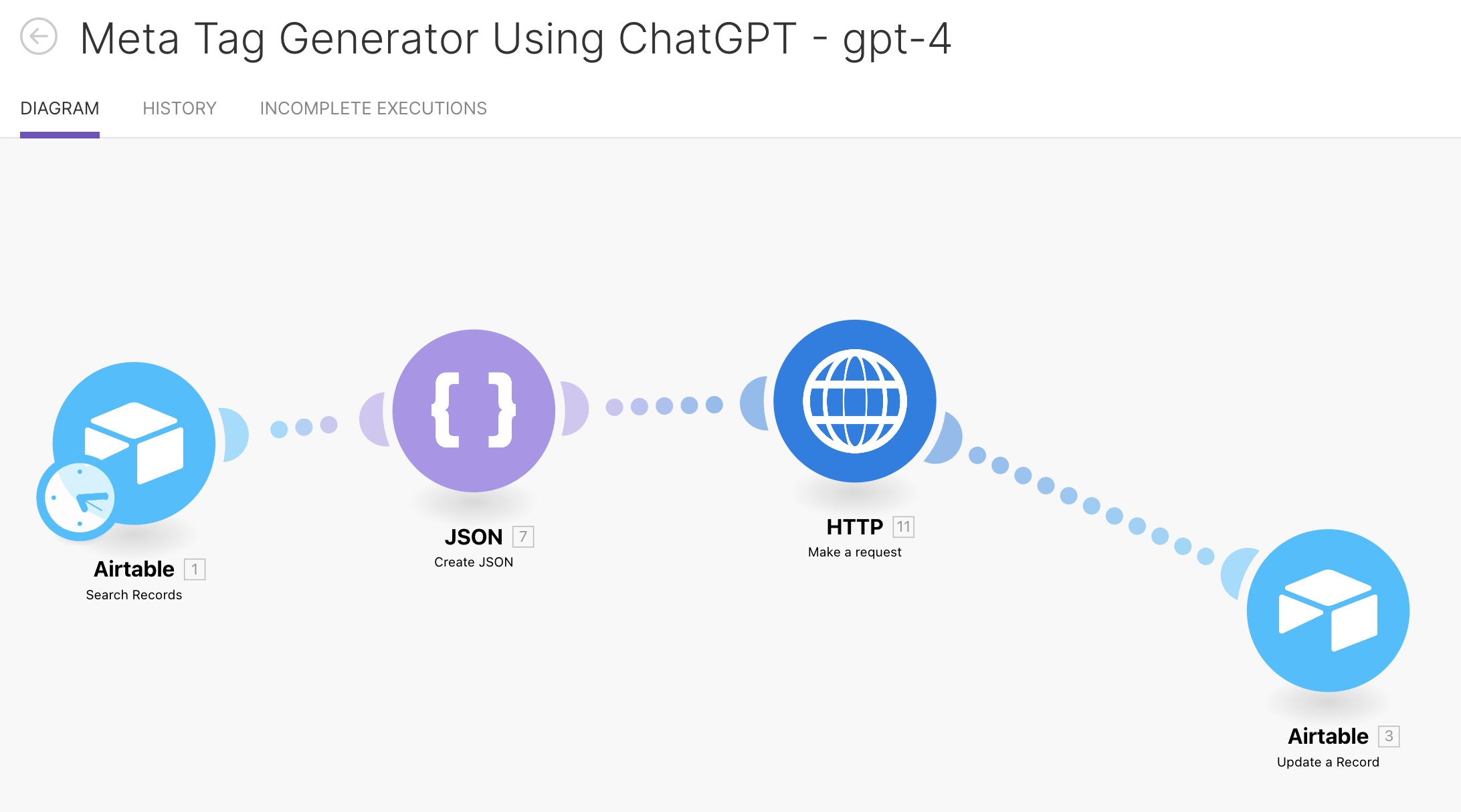
SEO Tags for a 2,000-Page Site, Overnight
A large website needed meta descriptions across roughly 2,000 pages, an estimated 40 hours of manual writing, so we built a no-code pipeline with GPT and Make.com that generated, reviewed, and loaded them overnight. The build is documented step by step in the post.

Two Diagnostic Products, Built AI-First
The Website Scorecard and the IMPACT Scorecard were designed, built, and shipped by our own AI-first delivery: scoring engines, tiered reports, PDF generation, and CRM integration. Both are live on this site, so try one and you are looking at the proof.

A Quality Gate That Runs Itself
Document review at enterprise scale usually means a senior person reading every draft against a rubric, which is slow, inconsistent between reviewers and impossible to staff at volume. We build gates that score a document against a client's own published rubric and return a pass, revise or escalate call with the reasoning shown. One runs in production for a global financial institution, triggered by the client's own team, with the output landing in their channel and their folder. The judgement stays human; the reading does not.
AI Automation Services FAQs
An automation follows a fixed set of rules every time, so it is the right choice when the steps never vary, such as moving a lead record between systems or reformatting a report. An agent is given a goal, the context to work from and the tools to use, then decides the steps itself, which is what the work needs when it involves judgement, like drafting to a brief or interpreting a set of numbers. Most useful builds are both: a deterministic pipeline carrying the data, an agent doing the one or two steps that genuinely require reasoning, and a person approving the output. If you are not yet sure which workflow to point a build at, that is the question AI marketing consulting answers, and both sit inside our wider AI and automation services.
Yours. Agents get built into the marketing automation, CRM, analytics and asset systems your team already uses, because a build that lives in a separate tool becomes one more place to visit and quietly stops being visited. Tool selection follows the workflow rather than leading it, and where a new component is genuinely needed we tell you what it costs to run before we build on it. Everything we produce, including the prompts, the grounding layer, the integrations and the documentation, is handed over as yours to keep and run.
Governance is designed into the build rather than added afterwards. We define which data may enter which model, who approves what, and what gets logged, so brand and legal keep line of sight without policing anything manually, and human approval sits at every point that is published, client-facing or regulated. For regulated categories and government work those rules are agreed before the first line of the build, and the whole configuration is documented and handed to you at the end.
Builds are priced as fixed scope rather than as a retainer, and the cost is driven by the workflow rather than by a rate card, because what varies is how much grounding the build needs and how many systems it has to reach into. Single-workflow builds start at $15,000 and usually run six to eight weeks from the first documentation session to handover, with the final scope and price set after a conversation about the workflow rather than guessed beforehand. If the workflow turns out not to be worth automating, we say so at that point rather than after you have paid for a build.
A single workflow typically takes six to eight weeks from the first documentation session to handover, with the agent running alongside the manual process for the last couple of those weeks. Documentation and redesign take up more of that time than the engineering does, which surprises most teams and is also the reason the builds survive contact with a real approval chain. A programme across a whole function runs on a quarterly rhythm, shipping two or three builds a quarter once the shared grounding layer exists.
It will, so the build is designed around that rather than in the hope of avoiding it. Quality gates are encoded as checks the pipeline has to pass, a person approves anything published, client-facing or regulated, and every run is logged so a bad output can be traced back to the step that produced it and fixed there. The only workflows we let run unattended are the ones where the cost of an error is low and the check is cheap, and we draw that line with you at design time instead of after an incident.
Tell Us the Workflow That Hurts
Most teams already know the answer to that, and it is usually the reporting pack, the content queue, or the enrichment nobody has time to do properly. Send us the workflow and we will tell you whether it is worth automating, what the build would involve, and what it would take for your team to run it afterwards without us. If the honest answer is that the process should be fixed rather than automated, we will say that too, before you spend anything.