
AI & Automation · Singapore
AI & Automation for Marketing Teams
Every marketing team has AI licences, but very few have AI in the operation. Two gaps keep it that way: imagination, because people cannot picture AI doing their own work until someone solves a real problem in front of them, and process, because tools laid over an unchanged workflow just make the old way faster. We find where AI changes your marketing economics, redesign the workflows that matter, and deliver our own services the same way.
The Problem
Why AI Stalls Inside Marketing Teams
The pattern repeats in every enterprise marketing team we meet: the tools are everywhere and the workflow has not changed.
Your Team Cannot Picture AI Doing Their Work
The training session happened and enthusiasm lasted a week, then everyone went back to the old workflow, because a demo on someone else's work changes nothing about yours. People adopt AI the moment they watch it solve a problem they own, in their own tools, on their own deadline, and until then it stays an interesting thing other teams are doing. That is an imagination gap, and no amount of licences closes it.
Fifty Experiments, No Shared Context
The copywriter drafts in ChatGPT, the analyst summarises data in a free tool, and someone built a custom GPT nobody else knows about. None of it compounds, because the organisation has given AI nothing to stand on: the data sits in silos, the processes live in people's heads, and the standards are implicit. AI is only as good as the context it can draw on, and almost no marketing team has built that layer of data, process, and standards it needs. In the Capgemini Research Institute's 2025 survey of 1,500 marketing executives, only 7% strongly agreed that AI had boosted their marketing effectiveness, which is what tools without context produce.
More Output, Same Pipeline
AI made the team faster, so the content calendar is fuller than ever, and pipeline has not moved. Speed bolted onto a 2022 playbook produces more of the same, sooner. McKinsey's State of AI survey found high performers are nearly three times as likely to have fundamentally redesigned their workflows, rather than bolting AI onto existing process. The redesign is the work. Most marketing teams sit at Level 1 of the maturity ladder, individuals working faster, and describe themselves as Level 3, systems redesigned. The gap between those two numbers is where the value sits, and no amount of extra output closes it.
Our Services
Three Ways to Put AI to Work
The method underneath is the same in every shape: document how the work is actually done, rebuild it as well-defined workflows grounded in your data and your standards, train your people in the new way of working, and only then automate what has earned it. Skip the grounding and AI guesses. We learned that sequence rebuilding our own agency's delivery, and it is what we install for clients.
Find the Workflows Worth Rebuilding
A four-to-six-week AI maturity assessment, then redesign and adoption across your markets.
- An honest maturity score on the four-level ladder, workflow by workflow
- The two or three redesigns worth making, with the value and cost of each
- Governance and data-handling gaps, written down
- Redesign sprints and a market-by-market adoption programme when you scale it
Build the Agents That Carry the Work
For teams that already know the workflow that hurts.
- Agents and pipelines for content operations, reporting, data enrichment and quality gates
- Built into the stack you already run, grounded in your data and standards
- Human approval wherever judgement matters
- The same builds run inside our own delivery every day
Get the Outcome Without the Rebuild
Every Construct Digital service already runs on redesigned, AI-carried workflows.
- SEO and GEO, content, campaigns, web builds
- Shorter cycles: more testing and iteration per quarter, not just faster drafts
- The same accountability and approval discipline as any CD engagement
- This website is the working example
Proof of Work
AI in Our Own Delivery, Measured
We rebuilt our own delivery before selling the method, so these numbers are what process redesign makes possible, measured before and after, on work that ships to clients every week.
Time cut on production footage review: 32 hours of work down to 4.
Publishing workflow rebuilt around AI: more than 8 hours of work down to 2.
Audit cycle down from more than 6 days to 2, run by an agent built on our own SEO framework.
A 2,000-page site's SEO meta descriptions, an estimated 40 hours of manual work, generated overnight by a no-code automation.
Proof
Work That Runs on AI Today
The AI service line is new, but the delivery behind it is not: a published automation case, a rebuilt client marketing engine, and two AI products live on this site right now.
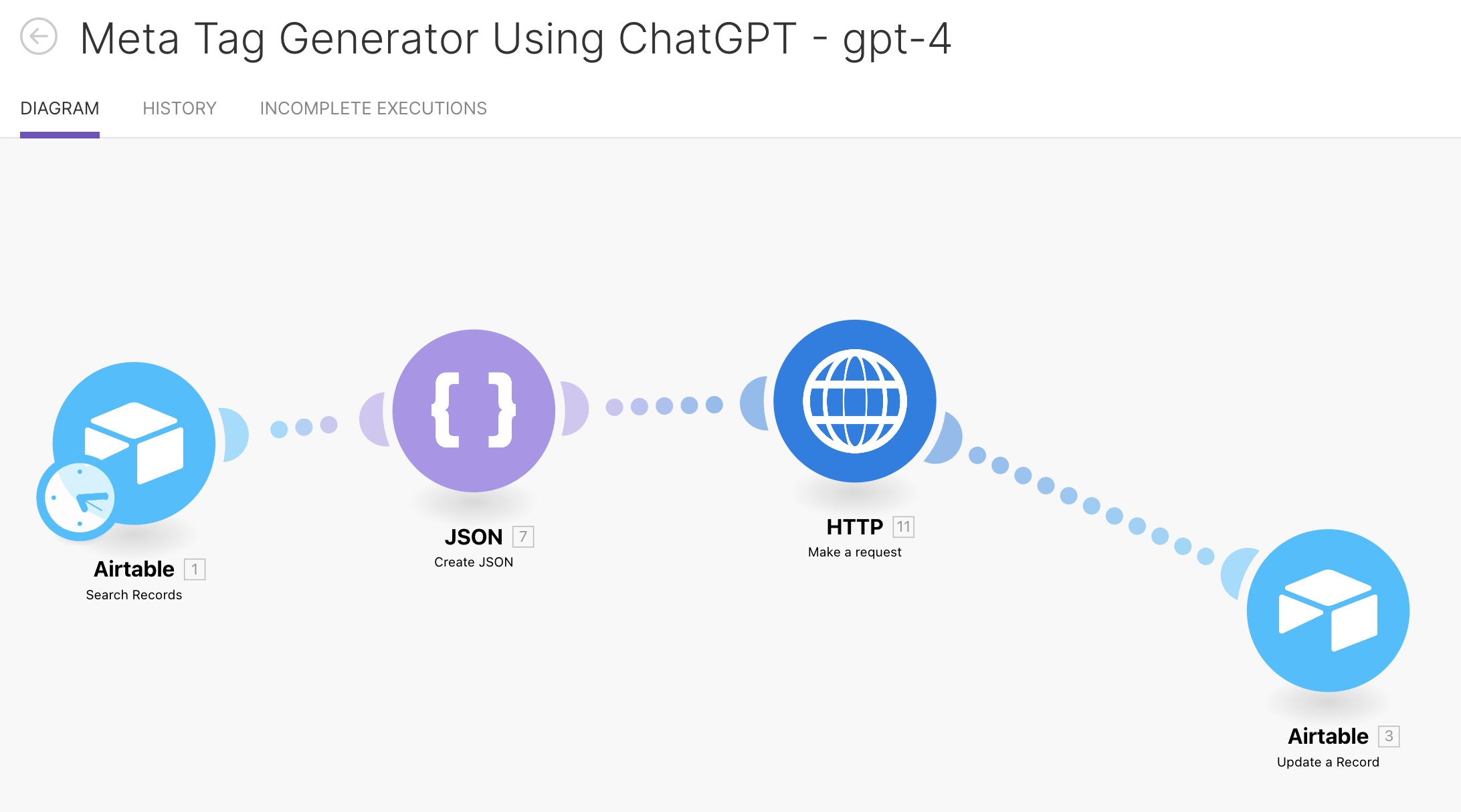
SEO Tags for a 2,000-Page Site, Overnight
A large website needed meta descriptions across roughly 2,000 pages, an estimated 40 hours of manual writing, so we built a no-code pipeline with GPT and Make.com that generated, reviewed, and loaded them overnight. The build is documented step by step in the post.
Prudential Singapore: One Always-On Engine
Prudential's email campaigns ran separately, team by team, with no shared engine underneath, so over 2025 we rebuilt the programme into a single always-on nurture engine on Salesforce. It won Gold for Most Effective Use of Marketing Automation at the MARKies 2026 Awards.

Two Diagnostic Products, Built AI-First
The Website Scorecard and the IMPACT Scorecard were designed, built, and shipped by our own AI-first delivery: scoring engines, tiered reports, PDF generation, and CRM integration. Both are live on this site, so try one and you are looking at the proof.
Got Questions
AI & Automation FAQs
AI and automation for marketing teams means redesigning how marketing work gets done so AI carries the mechanical load and people carry the judgement. In practice it covers three things: consulting and AI enablement to find where AI changes the economics of your marketing operation, custom agents and automated pipelines for the workflows that cost the most time, and marketing services delivered through AI-first workflows. It holds when the sequence is right: capture how the work is actually done, rebuild it as well-defined workflows grounded in your data and your standards, train your people in the new way of working, and only then automate what has earned it.
Start with the AI maturity assessment unless you already know exactly which workflow hurts. The assessment maps how work moves through your marketing function, scores it on the four-level maturity ladder, and produces a prioritised redesign list with costs attached, in four to six weeks. It is the entry point to AI marketing consulting and it stands alone as a deliverable. Teams that skip it usually automate the wrong workflow first. If you already know the workflow that hurts, start instead with AI automation services and custom agent builds.
In our own 30-plus-person agency, AI has replaced nobody. Every role expanded: project managers now generate working code, content strategists run UX audits, juniors deliver work that used to need a senior. AI replaces tasks. When the tasks disappear, the roles grow into the judgement work that was always underserved. The teams that get this right end up harder to poach, because their people are doing more interesting work than their peers.
Almost always the same thing: tools were bought and workflows were left alone. People were handed licences and told to experiment, with no shared prompts, no quality gates, no redesigned process and no measurement. That produces faster first drafts inside an unchanged operation, and after a year the honest answer to "what did this change?" is very little. The fix is sequence: diagnose which workflows are worth redesigning, rebuild those with AI in the loop, and measure cycle time before and after.
Governance is designed into the build, never bolted on. We define which data may enter which model, who approves what, and what gets logged, so legal and brand have line of sight without policing anything manually. Human approval sits at the judgement points: anything published, anything client-facing, anything regulated. For regulated categories and government work those rules are set before the first workflow is rebuilt, and the whole configuration is documented and handed over as yours.
AI-first delivery means the service you buy from us already runs on redesigned, AI-carried workflows: SEO and GEO, content production, campaign operations, web builds. The difference shows up in cycle time and in how much testing and iteration a quarter buys, and this website itself is maintained by AI agents working in git under human review. Most agencies added an AI line to the rate card. We rebuilt the delivery underneath it first.
Ready to Begin
See AI Working on Your Own Work
The fastest way to close an imagination gap is evidence from your own operation. Start with an AI maturity assessment: an honest score on the four-level ladder, a map of how work actually moves through your team, and a prioritised list of what to change first with the cost of each attached. If you already know the workflow that hurts, tell us about it and we will scope the build instead.