

In 2023, the exciting thing was the custom GPT: a version of ChatGPT you configured for one job, gave a name, and shared in a store. In 2026, the exciting thing is the agent: a system that takes a goal and does the work, rather than waiting for you to ask. If you are a marketer deciding where to spend your attention, that is the whole shift in one sentence. A few GPTs still earn their keep, but the advantage has moved to agents.
We wrote a “10 top custom GPTs” post back then, and going back to it makes the point better than we could. Almost every GPT we recommended is now abandoned, an anonymous store entry nobody maintained. That is not a knock on the idea. It is what happens when a format gets overtaken. So rather than hand you ten new links that will rot the same way, it is more useful to explain what a GPT is still good for, and where agents take over. For the tools that survived the same churn, see The Best AI Tools for B2B Marketers.
Custom GPT vs AI agent, at a glance
Custom GPT | AI agent | |
|---|---|---|
What it does | Answers when you ask | Takes a goal and completes the steps |
How it works | A saved prompt, knowledge and instructions | A model wired into your tools and workflows |
Best for | Repeatable thinking: brand voice, positioning, briefs | Repeatable doing: reporting, tagging, follow-ups |
Examples | Custom GPTs, Claude Projects, Gemini Gems | Make and n8n flows, ChatGPT and Claude agent modes, Claude Code |
The catch | It waits; it cannot act on its own | Needs setup and human guardrails |
What a custom GPT still does well
Strip away the store hype and a custom GPT is a saved configuration: a system prompt, some reference knowledge, and a set of instructions bundled so you do not rebuild them every time. For a repeatable task with a stable shape, that is genuinely useful.
The ones worth building are boring and specific. A brand-voice GPT loaded with your style guide, so drafts start in your tone. A positioning GPT that knows your ICP and messaging, so first drafts stop being generic. A brief-writer that turns a topic into a structured content brief the same way each time. Claude Projects and Gemini Gems are the same idea under different names, and if your team lives in one model, use its version for consistency.
The limit is built into the format. A GPT waits. It answers when asked and then sits there. It does not open your CRM, publish anything, or check back tomorrow. For a marketing team, that ceiling is the whole problem, because most of the work that eats your week is not a single answer. It is a sequence.
Where agents take over
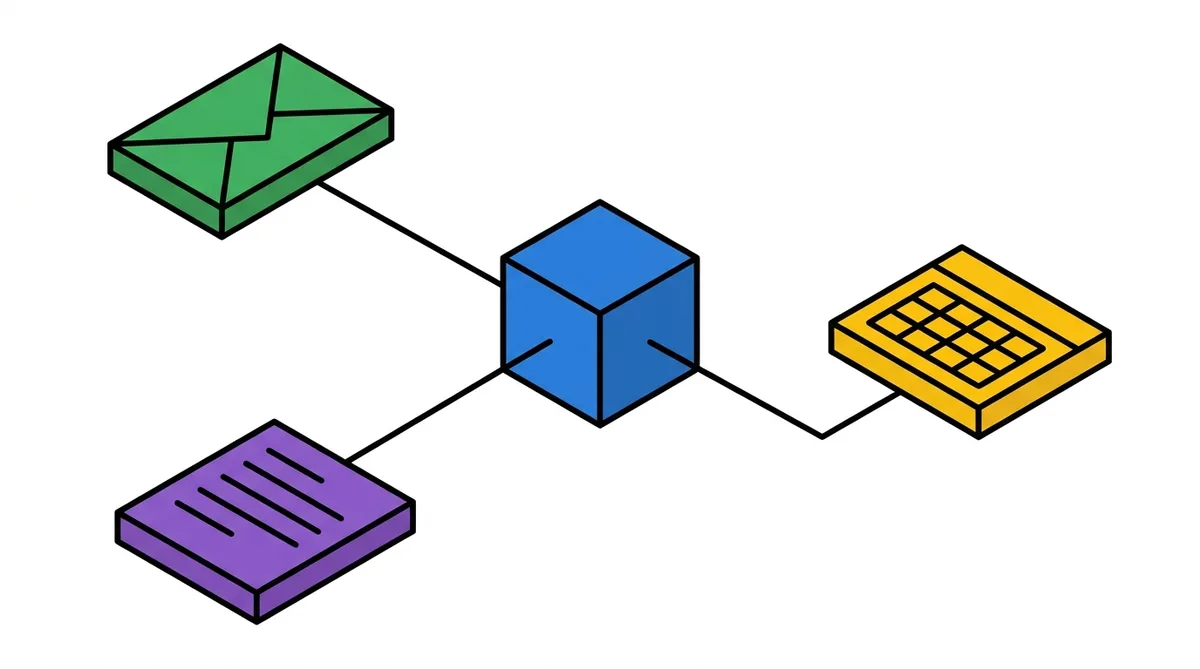
An agent takes a goal, breaks it into steps, uses tools, and finishes the job without you driving each move. The marketer’s version of this is not science fiction, and it is not a chatbot with a new label. It is a model wired into the systems where your work actually happens.
Three forms are worth knowing. Automation platforms like Make and n8n let you put a model inside a workflow that triggers on its own and lands a result somewhere real. Agent modes inside ChatGPT and Claude will now carry out a multi-step task in one go rather than answering a single prompt. And Claude Code, aimed at more technical hands, can build and run the automations themselves, or you can have the agents built for you. We go deeper on this in Future-Proof Your Marketing.
We run this website on the third kind. Construct’s own site is maintained by AI agents working in our codebase: they draft and revise content, handle SEO tasks, and run a monthly optimisation pass, with our team reviewing and approving rather than doing every step by hand. We also built a no-code automation, using Make plus a model, that generates and publishes SEO tags across the site on its own. None of this replaced a person. It moved our people from doing the repetitive work to directing it, the shift we make the case for in Stop Training Your Team on AI. That is the actual promise of AI that most tool lists talk around.
How to move from GPTs to agents
Start with the task you keep redoing, not the technology. Look for the job you or your team perform on a schedule, that follows the same steps each time, and that ends in an action rather than an answer. Reporting, tagging, repurposing, follow-ups. That is the first thing to hand to an agent.
Build the reusable GPT for the thinking, then wire the agent for the doing. Keep the brand-voice or brief GPT for consistency, and put an automation around the parts that should run without you. The teams pulling ahead in 2026 are not the ones with the most GPTs bookmarked. They are the ones who moved a real workflow from their to-do list into a system that runs it. That shift, and how to make it safely, is the work of our AI & Automation practice, including custom AI agents built into your stack.
FAQ
What is the difference between a custom GPT and an AI agent?
A custom GPT is a configured version of a chatbot that answers when asked. An agent takes a goal and completes a multi-step task using tools, without you driving each step. GPTs think with you; agents do the work.
Are custom GPTs still worth building in 2026?
Yes, for stable, repeatable thinking tasks: a brand-voice GPT, a positioning GPT, a brief-writer. Use Claude Projects or Gemini Gems if your team lives in those models. Just do not expect a GPT to take action on its own.
What AI agents can a marketing team actually use?
Automation platforms like Make and n8n with a model in the loop, the agent modes inside ChatGPT and Claude, and Claude Code for more technical builds. Start by automating one repetitive, scheduled workflow.
Do agents replace marketers?
No. In our own work they moved the team from doing repetitive tasks to directing them. The judgement, strategy and review stay human; the mechanical steps run on their own.
Put AI to Work in Your Marketing
AI maturity assessment, custom AI agents and automation builds, and AI-first delivery. See where AI changes the economics of your marketing operation, starting with your own workflows.